

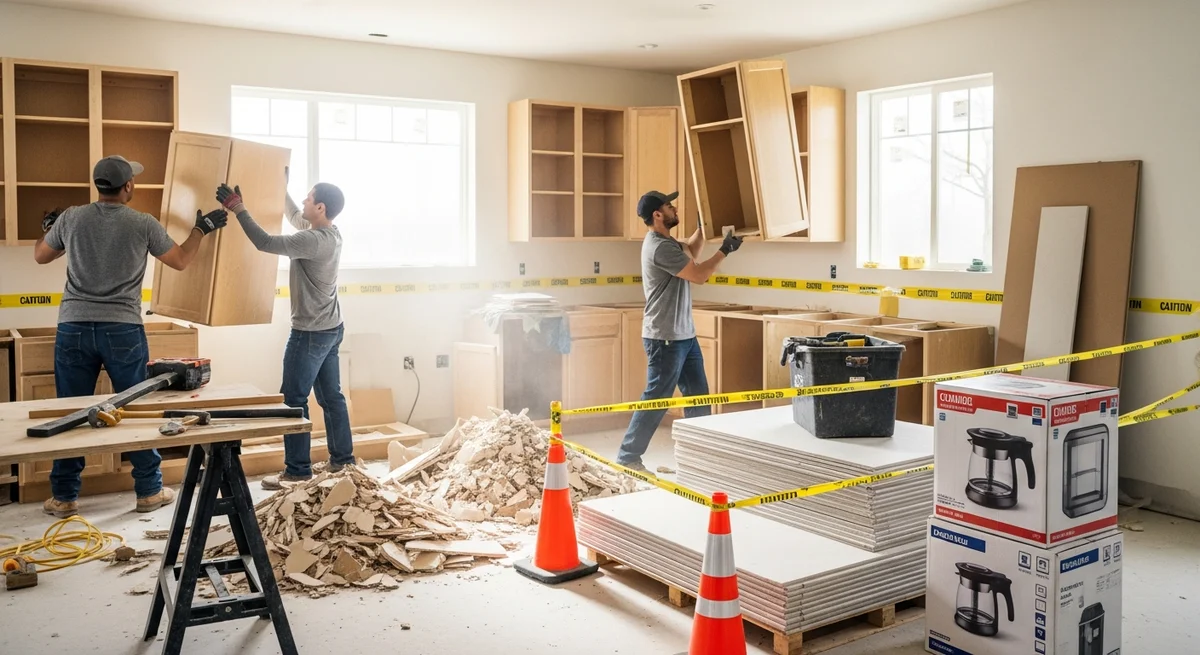
Tearing out an old kitchen and putting in a new one is a big job. Most homeowners want to know the full cost before they start. The price covers two main parts: taking out the old stuff and putting in the new. This guide breaks down what you can expect to pay for both.
A full kitchen demo costs between $500 and $5,000. Install costs depend on what you pick for cabinets, counters, and floors. Together, these can add up fast. Knowing what goes into each step helps you plan your budget and avoid surprises.
Demolition Costs And Process
What Does Demolition Include In A Kitchen Remodel?
Kitchen demo means removing everything that will be replaced. This starts with clearing out all items from cabinets and drawers. Then the work crew takes out the cabinets, counters, and appliances. Old flooring, backsplash tile, and light fixtures come out too.
Some jobs need more work than others. If you want to change your layout, our kitchen visualizer can help because walls may need to come down. Plumbing and electrical lines might need to be moved or capped off. The demo team also handles turning off water and power to keep the site safe.
How Much Does Kitchen Demolition Typically Cost?
Most homeowners pay between $500 and $2,500 for full kitchen demo. Small kitchens cost less, around $350 to $1,250. Large kitchens can run $2,500 to $5,000 or more. Contractors often charge $5 to $12 per square foot for this work.
Each part of demo has its own price tag. Cabinet removal runs $300 to $600, or about $15 to $20 per linear foot. Taking out counters costs $50 to $400. Tile removal adds $2 to $4 per square foot. Floor removal costs $1 to $5 per square foot. Wall removal ranges from $300 for simple walls up to $10,000 for load-bearing walls that need extra support.
Should I Pay For Demolition Or Do It Myself?
DIY demo can save you $200 to $500 on labor. But there are real risks to think about. You could get hurt swinging a sledgehammer or dropping heavy cabinets. You might miss hazardous stuff like asbestos or lead paint that pros know to look for.
Hiring pros costs $15 to $40 per hour for contractors or $50 to $80 per hour for handymen. They have the right tools and know how to dispose of waste properly. They also make sure your kitchen remodeling project stays up to code. If something goes wrong with DIY demo, it could void warranties on new items you install later.
What Needs To Be Removed Before New Kitchen Installation?
Everything old must come out before the new goes in. This means all cabinets, both upper and lower. Countertops and backsplash need to go. Old sinks, faucets, and garbage disposals get removed. The stove, dishwasher, and fridge have to be disconnected and moved out.
The floor usually needs to come up too, unless it is in great shape and works with your new design. Light fixtures, switches, and outlets may need to be pulled if you are changing their spots. Old drywall might come down if there is water damage or mold behind it.
Hidden Costs And Unexpected Issues
Are There Hidden Costs In Kitchen Demolition?
Hidden costs pop up when walls come down and problems appear. Homes built before 1980 may have asbestos in flooring, insulation, or drywall compound. Homes from before 1978 often have lead paint. Both need special handling that adds to the bill.
Water damage repair costs $1,361 to $6,270. Mold needs professional removal right away. Termite or pest damage can run $1,000 to $30,000 to fix. Outdated electrical work costs $600 to $36,000 to bring up to code. Bad plumbing adds $500 to $15,000. Rotted floor joists average $3,250 to replace. These issues are common in older homes needing full home remodeling and surrounding areas.
Does Demolition Uncover Unexpected Issues?
Yes, demo often reveals problems you could not see before. Once cabinets come off the wall, you might find water stains, mold, or rot. Old houses sometimes have outdated wiring like knob-and-tube that is a fire risk. Galvanized pipes in homes from before 1960 may be corroded and need replacing.
Foundation cracks sometimes show up when floors come out. These repairs cost $2,218 to $8,112 on average, but major issues can hit $25,000 or more. The good news is finding these problems now means you can fix them before your new kitchen goes in.
Should Contingency Funds Be Higher For Full Replacements?
Yes, experts say to set aside 10% to 20% of your budget for surprises. If your home was built before 1980, aim for the higher end at 15% to 20%. Older homes are more likely to have hidden problems that add cost.
For a $30,000 kitchen renovation, that means keeping $3,000 to $6,000 extra on hand. This money covers things like fixing rot, updating wiring, or dealing with code issues. Having this buffer keeps your project on track when surprises come up.
Installation Costs And Timeline
What Is The Cost Breakdown Between Demo And Installation?
Demo makes up a smaller part of the total cost. Labor for the whole project runs 20% to 35% of your budget. Demo itself usually costs $500 to $2,500 for most kitchens. The bigger costs come with installation and materials.
Cabinet install labor runs $50 to $200 per linear foot. For a typical 12x12 kitchen, that is $1,500 to $3,000 just for labor. Counter install adds $20 to $50 per square foot in labor, with most jobs running $300 to $740. Appliance install varies from $70 for a cooktop to $650 for a sink setup. Floor install for a 144 square foot space costs $500 to $1,500.
How Long Does Demo And Installation Take?
Demo goes fast compared to the rest. Most full kitchen demos take 2 to 5 days. Cabinet removal alone takes 5 to 8 hours. The whole demo phase wraps up in 1 to 2 weeks even for bigger jobs.
Install takes longer. Cabinet installation needs 1 to 3 days. Counters take an afternoon to install, but you wait 1 to 2 weeks for templating and making them first. Rough-in work for plumbing and electric runs 1 to 2 weeks. The whole remodel process takes 3 to 8 weeks for construction and 4 to 12 weeks total when you count planning.
Disposal And Salvage Options
What Disposal Costs Should I Expect For Old Materials?
Dumpster rental is the main disposal cost. Most people pay around $360 per week. A 10-yard dumpster costs $220 to $580 per week and holds enough for a small kitchen. A 20-yard dumpster runs $268 to $657 and works for most full kitchen remodels.
Watch out for extra fees. Going over the weight limit adds $40 to $200 per ton. Landfill fees run $20 to $50 per ton. Hazardous waste like asbestos needs special disposal and can cost extra. Improper disposal can mean fines up to $500, so make sure your contractor handles this right.
Can I Salvage Anything From My Old Kitchen?
Yes, many items can be saved and reused or donated. Cabinets in good shape can go to Habitat for Humanity ReStore. Working appliances have value too. Light fixtures, hardware, and faucets may work in other rooms or sell online.
Careful removal, called deconstruction, costs more at $7 to $14 per square foot. But you may get tax deductions for donated items. Some homeowners save usable wood or countertop pieces for garage projects. Just know that salvage takes more time than regular demo, which could affect your project timeline.
Preparing For Kitchen Demolition
How Do I Prepare My Home For Kitchen Demolition?
Start by clearing everything out of the kitchen. Empty all cabinets and drawers. Move small appliances, dishes, and food to another room. Take down any wall art or decorations. Cover or move furniture in nearby rooms since dust travels far.
Set up a temporary cooking spot with a microwave, coffee maker, and mini fridge. Stock up on paper plates and easy meals. Know where your water shutoff and electrical panel are. Clear a path from the kitchen to the door for hauling out debris.
What Protection Measures Are Needed During Demo?
Dust control is the top concern. Workers use 6-mil plastic sheeting to seal off the work area. ZipWall systems with spring-loaded poles make quick barriers. The plastic should cover walls, ceiling, and floor to create a contained space. Adhesive zippers let people get in and out without letting dust escape.
Floors outside the work zone need protection too. Ram Board or hardboard works for heavy demo traffic. Rosin paper covers stairs and hallways. Cardboard protects door frames and railings from bumps and scratches. Covering HVAC vents stops dust from spreading through your house. Air scrubbers create negative pressure to pull dust away from living areas.
Start Your Kitchen Project With Expert Help
Kitchen demo and installation costs add up, but knowing what to expect helps you plan. Budget for demo, install labor, materials, disposal, and surprises. Set aside that contingency fund for peace of mind. Mayflower Kitchen and Bath helps homeowners across Northern Virginia plan and complete kitchen projects that fit their budget and timeline. Get started with a consultation to see what your new kitchen could look like.