July 18, 2026
What Does Homeowners Insurance Cover for Home Repairs?

DESIGN


Key Takeaways
After your insurance company assigns a claim number for home damage in Virginia, the decision that matters most is selecting a qualified reconstruction contractor. Most Northern Virginia homeowners know the insurance side (calling the insurer, filing the claim, waiting for the adjuster) but are unfamiliar with how the contractor engagement process actually works from that point forward. This guide walks through that process step by step: from the morning after damage occurs through final close-out, so you know what to ask, what to expect, and what to avoid. The primary keyword here is homeowners insurance claim home repair Virginia, and the answer is: six steps, each with a specific action on your part.
Disclaimer: This article is intended to help Virginia homeowners understand the reconstruction contractor process after an insurance claim. It is not legal or insurance advice. Every policy is different, so review yours carefully and consult a licensed public adjuster or attorney if you have questions about your coverage.
Insurance home repair is reconstruction work performed after a covered loss: a burst pipe, fire, wind or hail damage, or vandalism. It differs from a renovation you plan and budget for yourself in one fundamental way: the scope of work is determined in part by an insurance adjuster, and payment flows from your insurer (minus your deductible) rather than from savings or a home equity loan.
The contractor's role in this process is narrow and specific: assess the damage, provide an accurate estimate for the repair, perform the work to current Virginia building code, and document everything thoroughly. At Mayflower, we are a reconstruction contractor; we build and restore. We are not a public adjuster, and we don't negotiate your policy on your behalf. What we do is give your insurer accurate, documented repair costs and complete the physical work.
In Northern Virginia, the most common insurance repair scenarios we handle involve sudden water damage from burst pipes (especially in the 1970s and 1980s brick colonials and split-levels that make up a large share of homes in Fairfax, Burke, Springfield, and Annandale), fire and smoke damage, and storm damage from wind and hail. Learn more about what homeowners insurance typically covers before you go into a claim conversation with your insurer.
The hours immediately following a loss matter. Before a contractor is even contacted, take these steps:
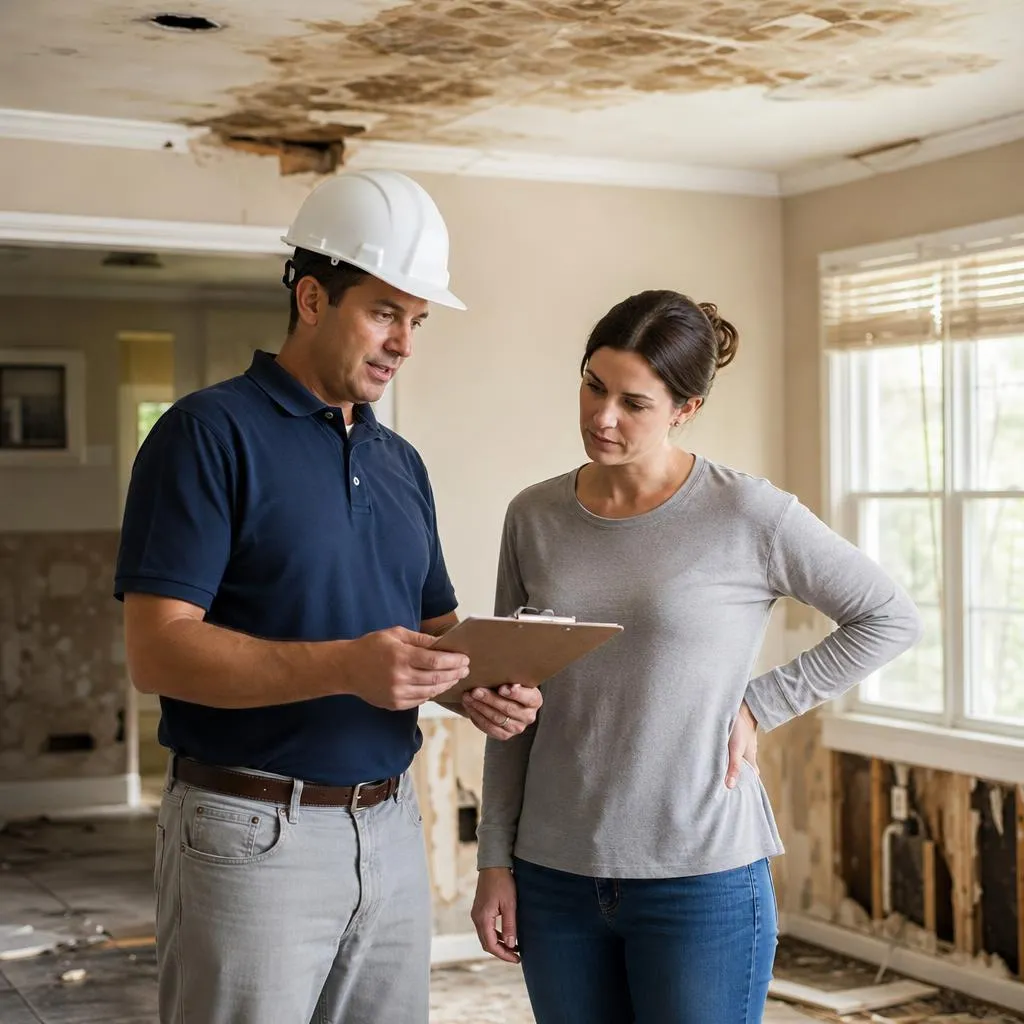
An adjuster, whether an employee of your insurer or an independent adjuster hired by them, inspects the damaged property, determines what's covered under your specific policy, and produces two key documents: a Scope of Loss and an estimate.
The Scope of Loss is a line-item description of every damaged component: square footage of flooring, linear feet of baseboard, square footage of drywall, number of cabinet boxes, area of tile, and so on. The accompanying estimate assigns a dollar value to each line item, typically using an industry-standard estimating platform called Xactimate, which pulls from regional pricing databases.
A few things every Northern Virginia homeowner should understand about the adjuster's estimate:
Not every contractor is equipped to work within an insurance repair process. Here is what distinguishes one who is:
The table below shows how different contractor types fit into the insurance repair process:
| Contractor / Professional Type | What They Do | What They Do Not Do | Licensed by |
|---|---|---|---|
| Reconstruction Contractor (e.g., Mayflower) | Performs the physical repair; documents scope; submits supplements | Negotiate your claim; act as your policy advocate | Virginia DPOR |
| Public Adjuster | Advocates for you with your insurer; reviews your policy; argues for higher settlement | Perform any physical repair work | Virginia SCC |
| General Remodeler | Renovation work you initiate | May not understand Xactimate or supplement process | Virginia DPOR |
| Storm-Chasing Contractor | Targets storm-damaged neighborhoods; often out-of-state | Provide local accountability or warranty | Often unlicensed or out-of-state |
You can read more about evaluating contractors in our guides on how to choose the right contractor and signs of a trustworthy contractor. Our insurance home repair services cover full reconstruction from scope through permit close-out.
This is the moment that catches the most homeowners off guard, and it happens on virtually every significant insurance repair. You receive the adjuster's estimate. Your contractor provides their own. The numbers are different. This is not a red flag; it's a predictable outcome with well-understood causes.
When you have both documents, the productive next step is to review them together and identify the gaps. Those gaps become the basis for a supplement request.
A supplement is a formal request to your insurer to add line items or increase amounts on an approved claim. It's filed when the actual cost of completing the repair exceeds the adjuster’s initial scope, which on significant insurance repairs is more common than not.
Supplements are not aggressive or unusual. They are a standard part of the insurance repair process. The supplement request documents what the repair actually requires, including photos, measurements, and written descriptions of what was found during demolition, and submits that documentation to the insurer for review. The insurer then approves, negotiates, or denies each line item.
The supplement process generally follows this sequence:
Mayflower handles supplement documentation and submission as part of our standard insurance repair process. We document what the repair requires and submit that documentation accurately; we are representing the repair scope, not acting as your policy advocate.
Any insurance repair that touches structural components, electrical systems, or plumbing requires a permit in Fairfax County and most Northern Virginia jurisdictions, just as a renovation would. Your contractor should pull the required permits and schedule inspections. If they suggest skipping permits on an insurance repair, treat that as a serious red flag.
The code compliance question gets complicated when a repair requires bringing adjacent systems up to current standards. For example: replacing water-damaged drywall in a 1980s Fairfax County home might expose knob-and-tube wiring, an undersized electrical panel, or plumbing that doesn't meet current code. Fairfax County building inspectors will require those systems to meet current NEC and Virginia Uniform Statewide Building Code standards before issuing final approval.
Who pays for that? It depends on your policy. Ordinance and law coverage (sometimes called building ordinance coverage) is a separate endorsement that pays for required code upgrades triggered by a covered loss. If you have it, your insurer picks up those costs. If you don't, they come out of your pocket. In Fairfax County, code-upgrade costs can range from a few hundred dollars (adding required GFCI outlets) to several thousand dollars (electrical panel replacement, egress window additions, structural upgrades).
Before the repair begins, ask your insurer directly: "Does my policy include ordinance and law coverage, and what is the limit?" It's a question that can save thousands of dollars in surprises later.
After a major storm or freeze event, Northern Virginia sees an influx of contractors targeting damaged neighborhoods. Some are legitimate and well-qualified. Others are not. Here's what to watch for:
The close-out phase has more steps than most homeowners anticipate, and skipping them can leave money on the table or create future complications.
If you'd like to understand more about what your policy covers before you reach the close-out stage, our guide on what homeowners insurance typically covers for home repairs breaks down covered perils, exclusions, and the ACV vs. RCV distinction in detail.
Do I need a contractor before or after the insurance adjuster visits?
You can involve a contractor at either point, and having one present during the adjuster's inspection often helps. An experienced contractor can identify damage the adjuster may overlook and document conditions that support a supplement request later. What you should not do is start permanent repairs before the adjuster's visit — doing so can create disputes about the pre-loss condition of your home and may complicate your claim.
Can a contractor negotiate with my insurance company on my behalf?
A reconstruction contractor can document the full scope of repair, submit a supplement request when repair costs exceed the adjuster's estimate, and communicate with your insurer about what the work requires. What a contractor cannot do is act as your legal or insurance advocate — that is the role of a public adjuster or attorney. Mayflower handles supplement documentation and submission as part of our standard process, but we represent the repair scope, not your policy.
What is a public adjuster and how are they different from a contractor?
A public adjuster is a licensed professional who represents you in negotiations with your insurer — they review your policy, inspect the damage, and advocate for the highest justifiable settlement. A contractor performs the physical repair work. The two roles are completely separate. In Virginia, public adjusters must be licensed by the State Corporation Commission. Some homeowners hire a public adjuster for complex or disputed claims; others work directly with their insurer.
How do I know if a contractor is qualified for insurance repair work in Virginia?
Verify their Virginia contractor license at DPOR.Virginia.gov — look for a Class A, B, or C license depending on project size. Ask for a certificate of insurance showing general liability and workers' compensation. Ask specifically whether they have experience reading Xactimate scope documents and submitting supplement requests. Request references from Northern Virginia insurance repair projects completed within the past two years.
What should I do if the insurance payout doesn't cover the full repair cost?
First, confirm whether demolition revealed additional damage not in the initial scope — that is the basis for a supplement request your contractor can prepare. Second, verify whether ordinance and law coverage applies to any code-upgrade costs the repair triggered. Third, check whether your policy pays actual cash value (ACV) or replacement cost value (RCV), since ACV policies subtract depreciation and the gap can be significant. If you believe the settlement is still too low after those steps, a licensed Virginia public adjuster or an insurance attorney can review your options.
An insurance repair in Northern Virginia is manageable when you understand each step and who is responsible for it. Document the damage thoroughly before anything is touched. Get a licensed Virginia contractor involved early. Review the adjuster's scope against the contractor's estimate before work starts. File a supplement if demolition reveals hidden damage. Verify your ordinance and law coverage before the repair begins. And walk away from any contractor who offers to waive your deductible. No exceptions.
If you have a claim number and need a licensed reconstruction contractor serving Fairfax County, Vienna, McLean, Arlington, Reston, Herndon, and the surrounding Northern Virginia area, schedule a free consultation with Mayflower. We manage scope documentation, permit coordination, and supplement submission from start to finish. Call us at (571) 380-7600 or contact us online to get started.
Figures and legal references are current as of 2026. Virginia statutes and building code requirements may be updated; verify current requirements with your insurer and local building department.