May 20, 2026
What Makes a Home Renovation Truly Custom? A Northern Virginia Homeowner's Guide

DESIGN


Key Takeaways
Most homeowners planning a custom home sauna spend their energy choosing wood species, bench heights, and tile finishes — and treat the heater like a line item to fill in at the end. That approach is backwards. The heater is the single most safety-critical component in the entire build, and it's the one piece of equipment that determines whether your sauna actually feels like a sauna or just a warm room with cedar walls.
Custom home saunas have become one of the most requested additions we see in Northern Virginia — particularly in larger homes in McLean, Great Falls, Vienna, and Potomac. As that demand has grown, so has the range of heaters on the market: from budget-tier imports with no safety listing to commercial-grade units designed for hotel spas. The gap in quality is enormous, and the consequences of getting it wrong range from disappointing sauna sessions to genuine fire and electrical hazards.
This guide covers everything you need to choose a quality sauna heater: how they work, the difference between heater types, what quality actually looks like in concrete terms, how to size one correctly for your room volume, and what a complete installation realistically costs in Northern Virginia.
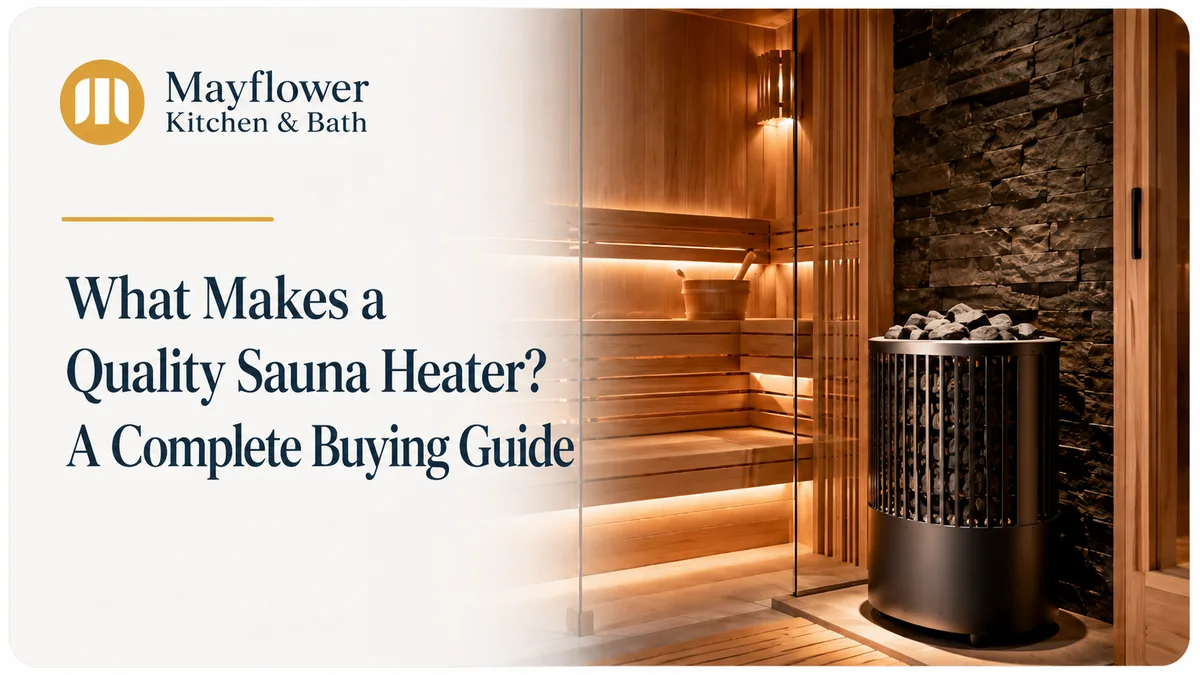
A sauna heater isn't a space heater in a box. Electric models use resistance coils to heat a bed of specially chosen volcanic rock — typically peridotite or olivine diabase — selected because they hold heat well and resist fracturing under repeated thermal shock from heating and sudden water contact.
When you ladle water onto those hot rocks, you get löyly: the burst of humid heat that creates the enveloping sensation that makes a sauna feel like a sauna rather than a very warm room. That's the core of the traditional Finnish experience, and it's also why a sauna heater has to do something a normal space heater never does: sustain 150–195°F in an enclosed, high-humidity environment for extended periods, safely, session after session.
The rock bed is what makes quality matter so much. A heater with a small or poorly designed rock basket produces weak, short-lived löyly and uneven heat. A heater with the right thermal mass holds temperature steadily, recovers quickly after water is added, and feels entirely different from a budget unit in the same-sized room.
Electric heaters are the practical choice for most residential installations in Northern Virginia. They require no venting, heat up in 30–45 minutes, and give you precise temperature control. Because there's no chimney or flue to design around, they integrate cleanly into an indoor sauna built as a conversion within an existing home — by far the most common scenario we work on in this area.
Wood-burning heaters are the traditional Finnish approach. They require a proper chimney, a flue, more hands-on maintenance, and more clearance planning — but many sauna owners prefer the quality of the heat and the ritual of tending a fire. Wood-burning heaters are most practical in detached outdoor saunas where running a chimney is not a structural constraint. For an indoor sauna addition in a Northern Virginia colonial or split-level, routing a compliant chimney through an existing structure typically adds more cost and complexity than makes sense.
Infrared panels are frequently marketed alongside sauna heaters but represent a genuinely different category. They heat your body directly through radiant energy rather than heating the air and rocks — and there is no löyly at all. If lower installation complexity or reduced electrical demand matters more to you than the traditional steam experience, infrared is worth understanding. But it is not a drop-in substitute for a traditional heater; the two experiences are fundamentally different.
Heater controls matter more than most buyers expect. Manual/analog controls use a simple dial on an external control panel mounted outside the sauna room — required by code. They work, but temperature accuracy drifts over time and there is no scheduling or automatic shutoff beyond a mechanical timer.
Digital controllers are now standard on most mid-range and premium heaters. They hold temperature more precisely, display both current and target temperature, and include a programmable timer so the sauna shuts off automatically. For a high-temperature electrical appliance, automatic shutoff is a meaningful safety feature — not a luxury.
App-connected controls let you preheat the sauna from your phone before you arrive home. It is a genuine convenience that many homeowners appreciate. That said, prioritize the fundamentals first: safety listing, rock capacity, correct sizing. Smart controls are a nice-to-have layered on top of a quality heater, not a substitute for one.
Here is what actually separates a quality heater from a cheap one — concrete criteria you can verify before purchase:
UL 875 listing (or CSA-equivalent). This is the non-negotiable baseline. UL 875 is the Underwriters Laboratories standard specifically for electric dry bath heaters. An unlisted heater is not just a fire risk — it can void your homeowner's insurance for any incident involving the sauna and create problems with local inspection sign-off. Verify the listing independently, not just from the product description.
Adequate rock capacity and a well-designed retention basket. More thermal mass means steadier heat, better löyly, and faster recovery after water is added. This is where budget heaters consistently cut corners — which is why inexpensive saunas often feel like standing next to a hot lightbulb rather than being enveloped in even, radiating heat.
Stainless steel elements and housing. A sauna operates at sustained high temperature and humidity — precisely the conditions that accelerate corrosion. Painted mild steel degrades faster, can give off odor as the coating breaks down at temperature, and simply does not last. Stainless is not an aesthetic preference here; it is a materials specification.
Accurate, well-placed temperature sensors. A thermostat sensor mounted too close to the heater or too close to the door gives inaccurate readings. The practical result: the control panel says the sauna is ready when actual bench-level temperature is 20–30°F short of target. This is a common source of disappointing first sessions in otherwise decent saunas.
Correct wattage for the room volume. Undersized heaters take too long to reach temperature and can never produce strong löyly. Oversized heaters push temperatures past comfortable and safe levels while wasting energy. Sizing is a technical specification — see the chart below.
Genuine safety cutoffs. A high-limit thermal reset is the minimum. Many residential models also include guard rails or tip-over protection — especially important in households with children or pets.
A budget heater does not just underperform. It systematically undermines the entire sauna investment in ways that take months or years to show up:
Safety and code compliance. Sauna heaters require a dedicated 240V circuit, and NEC Article 424 governs installation clearances, wiring specifications, and breaker requirements. A heater without a proper safety listing may fail inspection, requiring removal and replacement before a certificate of occupancy is issued.
Experience quality. Weak löyly, uneven heat, and long heat-up times are almost always heater problems — not wood or wall problems. Homeowners who do not know this end up blaming the room when the real issue is thermal mass and sizing.
Energy costs. A heater that is undersized for the room volume runs longer and harder to reach temperature. On a sauna used regularly, that inefficiency shows up on every electric bill.
Warranty and longevity. Improper installation voids most manufacturer warranties. An unlisted heater typically has no warranty coverage worth relying on. When something fails, replacement and labor come entirely out of pocket.
Not confirming electrical panel capacity first. A 9 kW heater draws roughly 37–40 amps and requires a specific breaker size and wire gauge. Buying the heater before confirming your electrical panel can support a dedicated 240V circuit is a common and expensive sequencing mistake — particularly in older Northern Virginia homes where original panels may already be near capacity.
Assuming all sauna rocks are interchangeable. They are not. Heaters are designed around specific rock sizes that allow proper airflow through the basket. Using undersized, oversized, or the wrong rock type restricts airflow, shortens element life, and reduces löyly quality.
Underestimating recovery time for back-to-back use. If multiple household members use the sauna sequentially, a heater that is adequate for one session may leave the second person waiting considerably longer for the room to return to full temperature. A slightly larger heater than the absolute minimum often makes practical sense for households with two or more regular users.
Prioritizing aesthetics over specs. A sleek housing tells you nothing about rock basket capacity, safety listing, element quality, or sensor placement. The fundamentals covered here matter far more than the finish.
Heater output must scale with room volume, not floor area. A 6x8 ft sauna with an 8 ft ceiling requires significantly more heater output than the same footprint with a 7 ft ceiling. Glass walls and uninsulated surfaces all increase heat loss further. The figures below are general industry rules of thumb — always confirm against your specific heater manufacturer's chart before purchasing.
Sauna VolumeTypical Heater OutputExample Room SizeUnder 200 cu ft4.5–6 kW~4x5 ft, 7 ft ceiling200–300 cu ft6–8 kW~5x7 ft, 7–8 ft ceiling300–425 cu ft8–9 kW~6x8 ft, 7–8 ft ceiling425–550 cu ft9–10.5 kW~7x9 ft, 8 ft ceiling550+ cu ft10.5 kW or multiple heaters8x10 ft or larger
The rule of thumb is roughly 1 kW per 45–50 cubic feet of sauna volume. From that baseline, add approximately 15–20% more heating capacity for each glass wall or exposed stone surface — both shed heat faster than an insulated cedar wall, and both are common design choices in custom Northern Virginia saunas.
Practical example: a 6x8 ft sauna with a 7.5 ft ceiling has a volume of 360 cubic feet, putting it in the 8–9 kW range. Add a glass front wall — common in interior saunas built into a basement or master bathroom — and you would typically size to 9 kW rather than the low end of the range.
Hardware cost and total installation cost are two very different numbers. Here is how the math typically works in the Northern Virginia market, where electrician rates and permit costs run 15–25% above national averages.
ComponentTypical Cost (NoVA 2026)NotesHeater unit (4.5–6 kW)$500–$900Smaller rooms; quality brands such as Harvia, HUUMHeater unit (6–9 kW)$800–$1,800Most common residential size rangeHeater unit (9–12 kW)$1,500–$3,000+Larger rooms; premium modelsDedicated 240V circuit + wiring$800–$2,500Depends on panel distance and routing complexityPanel upgrade (if needed)$1,500–$4,500Common in older NoVA homes with original panels near capacityElectrical permit (Fairfax/Arlington)$100–$350Required for new dedicated circuit
A typical residential sauna heater installation in Northern Virginia — quality 6–9 kW heater, dedicated 240V circuit, external control panel wiring, and licensed electrical labor — runs $2,500–$5,500 for the electrical and heater components. If the main panel needs an upgrade to support the new circuit (common in older Fairfax County and Arlington homes), add another $1,500–$4,500.
These figures cover heater and electrical only. The sauna room itself — wood, benches, vapor barrier, door, lighting, and ventilation — is scoped separately. You can learn more on our custom sauna construction services page.
Figures shown are typical ranges for Northern Virginia as of 2026 and vary based on home layout, panel capacity, room volume, heater brand, and site conditions. Contact us for a free on-site estimate.
Replace rocks every 1–2 years. Repeated thermal cycling causes rocks to crack and accumulate mineral deposits, reducing heat retention and steam quality. This is the most neglected maintenance item in residential saunas.
Use filtered or soft water for löyly. Hard water — common throughout Fairfax County and Arlington — deposits minerals on rocks and elements over time. Filtered water significantly slows that buildup.
Keep vents and housing clear of lint, dust, and debris. A quick visual inspection twice a year prevents most buildup problems.
Have wiring and connections inspected periodically. Sustained humidity is hard on electrical connections. A licensed electrician should inspect the circuit and connections every few years.
Run a burn-in cycle after rock replacement. After installing fresh rocks, run the heater for 30–45 minutes without adding any water so new rocks fully heat through before the first löyly session.
Even the right heater, correctly sized, will underperform — or create hazards — if it is installed wrong. A complete residential installation involves more steps than most buyers anticipate.
Before the heater ships, a licensed electrician should confirm that the electrical panel has capacity for the dedicated circuit. For most sauna heaters, that is a 240V circuit sized for the heater's amperage draw, wired with the appropriate gauge conductor and protected by the correct breaker. This work requires both an electrical permit and a licensed electrician — it is not a project for a standard outlet or a handy homeowner.
The heater is mounted at the manufacturer's specified clearance from all wall and bench surfaces — typically 4–6 inches from wood. Undershooting clearance is a fire code violation and a genuine safety hazard. The external control panel is wired and mounted outside the sauna room, with the sensor wire run through the wall at the correct height per the installation manual.
The rock bed is loaded to the manufacturer's minimum weight and arranged to allow proper airflow between rocks. An under-loaded or improperly arranged rock bed stresses the elements, reduces löyly quality, and shortens heater life. The first session should always be a burn-in cycle at low temperature before full operation begins.
Any of these steps done incorrectly — wrong breaker size, insufficient clearance, under-loaded rocks — can trip breakers, damage elements prematurely, or create code violations that surface at resale. This is why working with a contractor who manages the sauna build and coordinates the electrical work as a complete package matters. Our renovation process handles all of these components in the right sequence so nothing gets missed.
The most common custom sauna scenario we build in Northern Virginia is an interior room conversion — transforming a spare bathroom, a section of finished basement, or a large walk-in closet into a dedicated sauna room. These builds have practical considerations that affect heater selection from the very start.
Indoor saunas in existing homes almost always require running a new dedicated electrical circuit from the panel. The length and complexity of that run — through finished walls, across floors, or down from an upper level — is a major driver of electrical cost. Before selecting a heater, confirm with a licensed electrician what panel capacity is available and what the circuit run involves. This step should happen during the design phase, not after the heater is already ordered.
The second consideration specific to interior saunas is vapor barrier and wall assembly. A sauna room without a proper vapor barrier will eventually cause moisture damage to the surrounding structure — entirely separate from the heater but critical to how the project is scoped. If you are planning a custom sauna addition and want to understand the complete picture, our custom sauna construction services page covers how we approach these builds from electrical planning through final inspection.
UL 875 or CSA safety listing — verified independently, not just claimed in the product listing
Stainless steel heating elements and housing
Rock basket capacity adequate for your room volume — not undersized
Output sized to room cubic footage with upward adjustment for glass walls or uninsulated surfaces
High-limit thermal cutoff and accurately placed temperature sensor
Digital controller with timer and automatic shutoff
Electrical panel confirmed to support the dedicated 240V circuit before purchase
Installed to NEC Article 424 specifications by a licensed electrician with an electrical permit pulled
Mayflower Construction Group builds custom saunas throughout Northern Virginia — McLean, Vienna, Great Falls, Fairfax, Reston, and the surrounding DC Metro area. If you are planning a custom home sauna and want to talk through the scope — heater selection, electrical, wood, and everything in between — call us at (571) 380-7600 or explore our custom sauna construction services to get started with a free estimate.
