

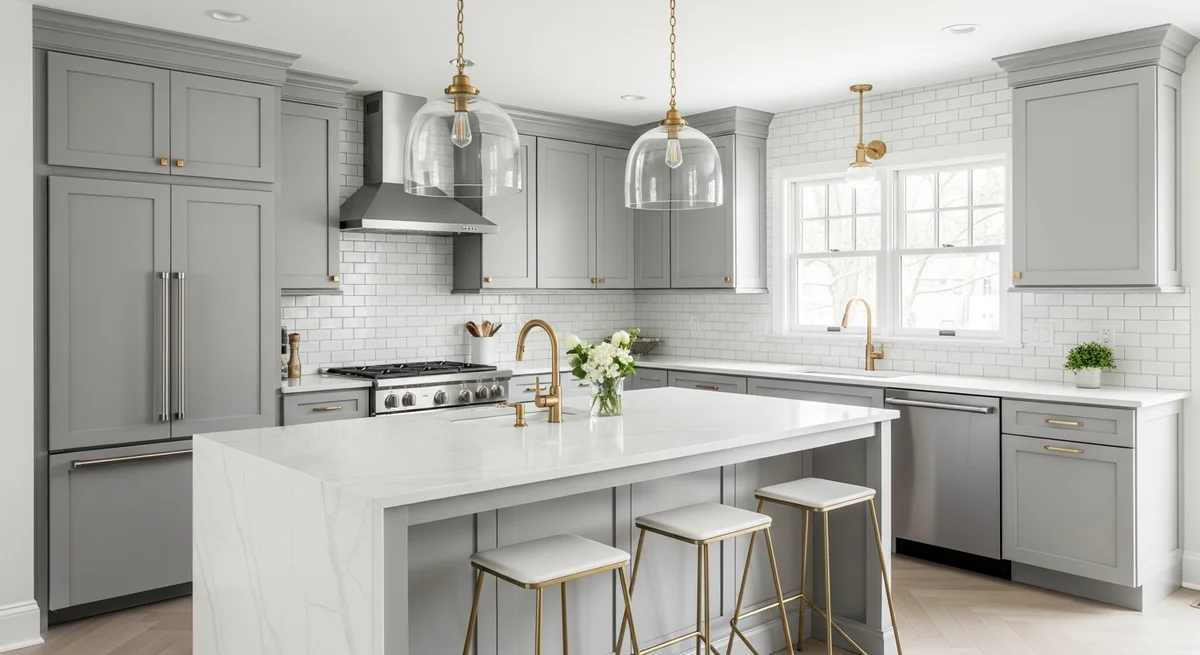
Key Takeaways
- Cap your total renovation spending at 30% of your home's current market value to avoid overcapitalizing — for a $500,000 home, that means a $150,000 maximum.
- Apply the more targeted 5–15% rule for individual rooms like kitchens to keep each project proportional to your home's worth.
- Get an accurate home valuation from a local real estate agent or appraiser before setting your budget, especially in Northern Virginia where values vary widely by neighborhood.
- Use the 30% ceiling to prioritize projects that add the most value and improve daily life, preventing financial strain from over-improvement.
The 30% rule for renovations is a budgeting guideline that says you should not spend more than 30% of your home's current market value on remodeling. So if your home is worth $500,000, you would want to keep your total renovation budget at or below $150,000. This includes everything: labor, materials, permits, and a cushion for surprise costs.
This rule helps homeowners avoid a common and costly mistake called overcapitalization. That happens when you put more money into your home than you can ever get back when you sell it. The 30% rule gives you a clear spending limit. It keeps your finances safe while still letting you create the home you want.
In this article, we will break down how the 30% rule works, why it matters (especially in a high-value market like Northern Virginia), how it applies to kitchen remodels, and when it makes sense to bend or follow this guideline.
Why the 30% Rule Matters for Homeowners
Home renovations can get expensive fast. A new kitchen alone can cost anywhere from $15,000 to well over $100,000 depending on the scope. Without a clear budget framework, it is easy to overspend.
The 30% rule matters because it:
- Protects your resale value. You do not want to become the most expensive home on the block with upgrades no buyer will pay extra for.
- Keeps your budget realistic. It forces you to think about what you truly need versus what would be nice to have.
- Helps you prioritize. When you have a ceiling, you focus on the projects that add the most value and improve daily life.
- Prevents financial strain. Staying within this limit means you will not drain your savings or take on too much debt.
Think of it like this: the rule is not about limiting your dreams. It is about making sure your dreams do not turn into a financial headache.
In Northern Virginia, where homes routinely sell for $600,000 to over $1 million, the 30% ceiling gives you a generous renovation budget in absolute dollars. A $700,000 home produces a $210,000 cap. That is plenty of room to do a full kitchen renovation, update a bathroom or two, and handle other improvements without overcapitalizing. The challenge is not having enough room to spend. It is being disciplined about how you spend it. Understanding the realistic budget for a kitchen renovation helps you allocate your 30% ceiling wisely across projects.
How to Calculate 30% of Your Home's Value
Calculating your renovation budget using the 30% rule is simple. Here is a step-by-step breakdown:
Step 1: Find Your Home's Current Market Value
You need an accurate number. Skip the rough online estimates if you can. Talk to a local real estate agent, look at recent sales of similar homes in your neighborhood, or get a professional appraisal.
In Northern Virginia, where home values vary widely by neighborhood, this step is especially important. A townhouse in Woodbridge might be valued very differently than a detached home in Vienna or McLean.
Step 2: Multiply by 0.30
Once you know your home's value, multiply that number by 0.30 (or 30%).
Example calculations:
- $400,000 home = $120,000 budget ceiling
- $664,000 home (NoVA median) = $199,200 budget ceiling
- $800,000 home = $240,000 budget ceiling
- $1,000,000 home = $300,000 budget ceiling
Step 3: Include All Costs
Your 30% budget should cover:
- Labor and contractor fees
- Materials (cabinets, countertops, flooring, fixtures)
- Permits and inspections
- Design and architectural fees
- A contingency fund (10 to 20% of your budget) for surprises
Many homeowners forget the contingency fund. Older homes in areas like Arlington, Falls Church, or Alexandria often have hidden issues like outdated wiring, plumbing problems, or structural quirks. Setting aside extra cash keeps you from going over budget when surprises pop up.
How the 30% Rule Applies to Kitchen Remodeling
Kitchens are often the biggest remodeling project homeowners take on. They are also one of the best investments you can make.
According to the 2025 Cost vs. Value Report, a minor kitchen remodel now returns about 113 percent of its cost nationally, making it one of the highest-ROI interior projects you can do. That means for every dollar you spend, you could get more than a dollar back in added home value. Major kitchen remodels return significantly less — typically 40 to 50 percent for a midrange major remodel — because the higher price tag is harder to recoup at resale.
Should You Spend 30% of Your Home Value on a Kitchen?
Not usually. The 30% rule is for your total renovation budget across all projects, not just one room. If you spend your entire 30% ceiling on the kitchen, you have zero budget left for bathroom updates, flooring, or any other improvements your home might need.
Most experts recommend spending about 5 to 15 percent of your home's value on a kitchen remodel specifically. For a $700,000 home in Northern Virginia, that translates to roughly $35,000 to $105,000 for a kitchen renovation project.
This range allows you to make meaningful upgrades like new cabinets, quality countertops, modern appliances, and better lighting without overcapitalizing. It also leaves room in your 30% ceiling for other projects.
Kitchen Renovation Budget Guidelines:
- $400,000 home = $20,000 to $60,000 kitchen budget (5-15% of value)
- $700,000 home = $35,000 to $105,000 kitchen budget
- $1,000,000 home = $50,000 to $150,000 kitchen budget
If you are planning a kitchen remodel along with other updates (like a bathroom renovation or basement finishing), make sure the combined total stays within your 30% ceiling. Prioritize the projects that add the most value and improve how you use your home day to day.
How the 30% Rule Applies to Bathroom Remodeling
Bathrooms are the second most popular remodeling project after kitchens. The same logic applies: stay proportional to your home's value.
Most industry guidelines recommend spending 3 to 7 percent of your home's value on a bathroom renovation. For a $700,000 Northern Virginia home, that means a bathroom budget of $21,000 to $49,000.
The 2025 Cost vs. Value Report shows that a midrange bathroom remodel returns about 80 percent of its cost at resale. That is a solid return, but it reinforces the importance of spending wisely. A $30,000 bathroom renovation in a $400,000 home (7.5 percent of value) makes good financial sense. A $60,000 bathroom renovation in that same home does not, because it pushes your per-room spending well past the proportion the market supports.
When planning multiple renovations, the 30% rule helps you divide your total budget across projects. For example, a homeowner with a $700,000 home has a $210,000 total ceiling. They might allocate $90,000 to a kitchen, $35,000 to a bathroom, and keep the remainder for flooring, paint, and contingency. That allocation keeps every project in proportion while staying under the 30% cap.
What the 30% Rule Means for Resale Value
The whole point of the 30% rule is to protect your investment. When you spend wisely, you are more likely to see a strong return when it is time to sell.
How Appraisers View Renovations
Appraisers look at your home and compare it to similar homes that have recently sold nearby. They consider:
- The quality of materials and workmanship
- Whether upgrades match the neighborhood standard
- How long ago the renovation was completed
A recent, well-done minor kitchen update can add about as much value as it costs (about 113% nationally), but larger kitchen and bathroom renovations recoup noticeably less. Our kitchen remodel ROI guide breaks this down. But here is the catch: that value fades over time. After 10 years, the added value from a renovation drops significantly.
The Neighborhood Ceiling Problem
Every neighborhood has a price ceiling. This is the maximum amount buyers are willing to pay for a home in that area, no matter how nice it is.
If you own a $500,000 home and spend $200,000 on renovations, your home is now worth $700,000 on paper. But if the highest sale in your neighborhood was $550,000, you have a problem. No buyer will pay $700,000 to live in a $550,000 neighborhood.
This is overcapitalization in action. The 30% rule helps you avoid it.
Is the 30% Rule Still Relevant in 2025?
Yes, but with some flexibility depending on your situation.
The housing market has changed a lot in recent years. Material costs went up. Labor costs went up. Home values climbed too, especially in places like Northern Virginia, where the median home price hit $664,000 in early 2025, according to Virginia REALTORS data.
The 30% rule remains a solid starting point. It gives you a framework to plan around. But it is not a hard-and-fast law. Your personal goals, timeline, and local market all play a role.
When to Stick Closely to the 30% Rule:
- You plan to sell within the next 3 to 5 years
- You live in a neighborhood with a clear price ceiling
- You are renovating for resale value, not personal enjoyment
- You want to avoid overborrowing or dipping into emergency funds
When You Might Exceed the 30% Threshold:
- You bought a fixer-upper well below market value
- You plan to stay in your home for 10 or more years
- You are in a high-value market where luxury upgrades are expected
- The renovation fixes major structural or safety issues
Does the 30% Rule Apply in High-Value Markets Like Northern Virginia?
This is a great question, and the answer is nuanced.
Northern Virginia is one of the priciest real estate markets in the country. The median home price here is almost double the national average. Homes in Vienna, McLean, Great Falls, and parts of Arlington regularly sell for $900,000 to well over $1 million.
In these high-value areas, buyers expect high-quality finishes. A $150,000 kitchen remodel in McLean might be standard. The same project in a more affordable neighborhood like Woodbridge or Manassas could price you out of the market.
What This Means for Northern Virginia Homeowners
The 30% rule still applies, but your ceiling is higher because your home value is higher. A $1 million home in Fairfax County gives you a $300,000 renovation budget under the 30% rule. That is a lot of room to work with.
However, do not assume a high budget means you should spend it all. Focus on projects with proven ROI:
- Kitchen remodeling with quality cabinetry and countertops
- Bathroom remodeling with modern fixtures and efficient layouts
- Energy-efficient upgrades (windows, HVAC, insulation)
- Curb appeal improvements
Working with an experienced contractor who knows the Northern Virginia market helps you make smart choices. A good contractor can tell you which upgrades buyers in your specific neighborhood expect and which would be overcapitalizing. That local expertise is especially valuable in a market where a home in Reston and a home in McLean — even at the same price point — may call for very different renovation approaches.
Another important consideration: Northern Virginia homeowners often renovate incrementally over several years rather than all at once. If that describes your plan, track your cumulative spending against the 30% ceiling. A $40,000 kitchen remodel this year, a $25,000 bathroom next year, and $15,000 in flooring the year after that adds up to $80,000. On a $600,000 home, that is only 13 percent — well within the guideline. But if you are not tracking the total, it is easy to overshoot.
What Happens If You Exceed the 30% Renovation Threshold?
Going over the 30% threshold does not automatically spell disaster. But it does increase your risk.
Potential Consequences:
- Difficulty selling. If your home is priced higher than comparable properties, it may sit on the market longer.
- Lower than expected appraisal. If you need to refinance or sell, the appraisal might come in lower than what you spent.
- Financial strain. Overspending on renovations can deplete savings, increase debt, or leave you house-rich but cash-poor.
- Reduced flexibility. Life changes. Job moves happen. If you have overcapitalized, you have less room to maneuver if you need to sell unexpectedly.
How to Mitigate the Risk
If you do decide to exceed 30%, be strategic:
- Make sure the upgrades have broad appeal (avoid overly personalized designs)
- Prioritize high-ROI projects
- Keep detailed records of all work for future buyers and appraisers
- Plan to stay in the home long enough for market appreciation to catch up
How the 30% Rule Relates to Return on Investment
The 30% rule and ROI go hand in hand. Both are about making smart financial decisions.
High-ROI Renovations to Prioritize (2025 Cost vs. Value Report):
- Garage Door Replacement: 194% ROI
- Steel Entry Door: 188% ROI
- Manufactured Stone Veneer: 153% ROI
- Minor Kitchen Remodel: 113% ROI
- Midrange Bathroom Remodel: 74% ROI
Notice a pattern? The highest returns often come from projects that improve curb appeal or update high-traffic areas without massive structural changes. These are the kinds of projects that fit comfortably within a 30% budget and still leave room for other improvements.
If you are deciding between two projects, compare their ROI alongside their percentage of your home's value. A bathroom remodel that costs $30,000 and returns 80 percent nets you $24,000 in added value. A swimming pool that costs $60,000 and returns 30 percent nets $18,000. The bathroom costs half as much, returns more value, and leaves room for other projects under your 30% ceiling.
Low-ROI Renovations to Reconsider:
- Swimming pools (often return less than 30%)
- Home theaters
- Overly personalized designs
- Major upscale kitchen remodels (under 45% ROI)
- Converting bedrooms to other uses
The 30% rule helps you stay focused on what matters. When you have a budget ceiling, you naturally gravitate toward projects that deliver the most bang for your buck.
Frequently Asked Questions
Does the 30% rule apply to all renovation types or just kitchens and bathrooms?
The 30% rule applies to your total renovation spending across all projects combined. It does not matter whether you are remodeling a kitchen, adding a bathroom, finishing a basement, or building an addition. The total cost of all renovation work should stay at or below 30 percent of your home's current market value to avoid overcapitalizing.
How do I find my home's accurate market value for this calculation?
The most reliable methods are getting a comparative market analysis from a local real estate agent (usually free) or hiring a licensed appraiser ($300 to $500). Online estimates from Zillow, Redfin, or Realtor.com provide a starting point but can be off by 5 to 10 percent or more, especially in Northern Virginia neighborhoods where home styles and lot sizes vary widely. Your county tax assessment is another reference point, though it often lags behind actual market values.
What if my home needs more than 30% in renovations?
If your home genuinely needs more than 30 percent of its value in renovations (for example, a fixer-upper with outdated systems, structural issues, or deferred maintenance), the rule becomes more of a financial awareness tool than a hard limit. In that case, you are likely renovating to bring the home up to market standard, which often recovers more of the investment at resale. The key is understanding that you are taking a financial risk and planning accordingly by prioritizing the improvements that add the most value first.
Should I include DIY labor in the 30% calculation?
Include the cost of materials you purchase for DIY work, but you do not need to assign a dollar value to your own labor. The purpose of the 30% rule is to track your actual out-of-pocket spending. If you do $5,000 worth of painting and landscaping yourself, only the cost of paint, supplies, and plants counts toward your total.
Is 30% the right number for every market?
The 30 percent guideline works well in most markets as an upper limit. In very high-value markets like parts of McLean or Great Falls where homes sell for $1.5 million or more, the ceiling is naturally higher in dollar terms, giving you substantial renovation room. In more affordable markets, the dollar ceiling is lower, which means you need to be more selective about which projects to tackle. The percentage stays the same, but the practical budget it produces varies with your home's value.
How to Save Money While Staying Within the 30% Rule
Staying under your 30% ceiling does not mean settling for a mediocre renovation. Smart spending strategies can stretch your budget without sacrificing the quality that Northern Virginia buyers expect:
- Reface cabinets instead of replacing them. If your cabinet boxes are structurally sound, new doors and drawer fronts can save 30 to 50 percent compared to full replacement while delivering a completely updated look.
- Keep plumbing in place. Moving a sink, toilet, or shower is one of the most expensive changes in a remodel. Keeping fixtures in their current locations saves $1,500 to $4,000 or more per fixture.
- Choose quartz over natural stone. Mid-grade quartz costs $50 to $80 per square foot installed and requires no sealing or maintenance. Many natural stone options in the same price range require ongoing care and are more vulnerable to staining.
- Use stock or semi-custom cabinets. Semi-custom cabinets ($250 to $600 per linear foot installed) offer extensive style, finish, and configuration options at 40 to 60 percent less than full custom ($500 to $1,200 per linear foot).
- Prioritize high-visibility areas. Spend more on countertops, the backsplash behind the stove, and cabinet fronts you see every day. Save on the pantry interior, under-sink storage, and areas hidden by appliances.
- Plan and finalize everything before demolition. Change orders during construction typically add 15 to 25 percent to a project's cost. Locking in every decision before the first hammer swings is one of the most effective cost-control strategies available.
For more detailed strategies on controlling kitchen renovation costs, see our guide on planning a kitchen renovation budget in Northern Virginia.
Plan Your Renovation Budget With Confidence
The 30% rule for renovations is a smart guideline that helps homeowners spend wisely. It protects your investment, keeps your budget in check, and makes sure your upgrades add real value to your home.
In a market like Northern Virginia, where home values are high and buyers have strong expectations, this rule is especially useful. It gives you a framework to plan ambitious projects without overextending yourself.
Whether you are updating your kitchen, remodeling a bathroom, or planning a whole-home transformation, the 30% rule keeps you grounded. Calculate your ceiling, prioritize high-ROI projects, and work with experienced professionals who understand your local market.
Ready to start planning your renovation? Call Mayflower Kitchen and Bath at (571) 380-7600 or schedule a free consultation. Our team specializes in kitchen and bathroom remodeling throughout Northern Virginia, helping homeowners create beautiful spaces that deliver lasting value.