September 13, 2022
What Goes into Picking Kitchen Materials in NoVA?

KITCHEN


Key Takeaways
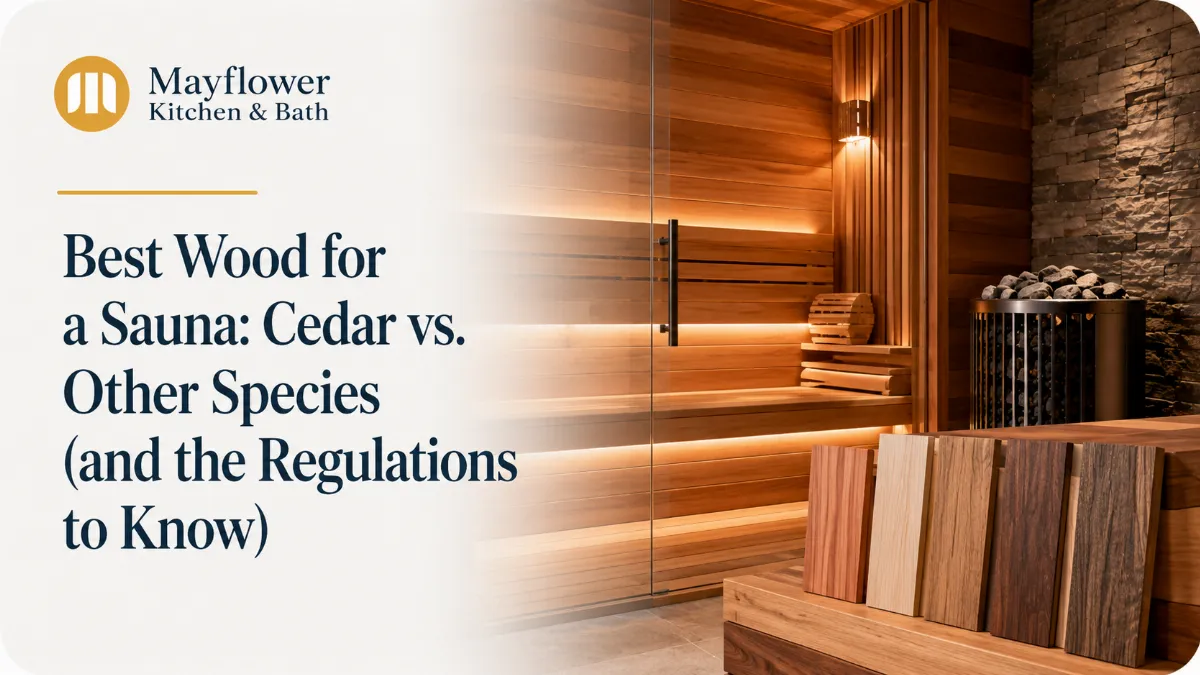
Wood choice in a sauna isn't primarily an aesthetic decision. It's a performance and safety decision that happens to also look good. A sauna subjects wood to a punishing cycle: repeated swings between 150–195°F heat, near-100% humidity spikes from löyly, and direct, repeated skin contact on hot surfaces. Not every species holds up to that, and some are outright unsafe to use. Here's what actually matters when choosing sauna wood, how the common species stack up, and the regulations worth knowing before you build.
Three properties separate a good sauna wood from a bad one:
Low density and thermal conductivity: a wood that stays cool enough to touch even after sitting under heat for an hour, rather than one that transfers heat quickly enough to be uncomfortable (or worse, capable of a minor burn) on contact.
Low resin/pitch content: high-resin woods bleed sap when heated, which can burn skin, stain surfaces, and produce an unpleasant smell as it cooks.
Dimensional stability and rot resistance: a sauna's wet-hot-to-cool-dry cycle, day after day, will warp, crack, or grow mold in the wrong species over time.
The classic choice, and for good reason. Cedar heartwood naturally contains compounds called thujaplicins that give it real rot and insect resistance without any chemical treatment. It has an attractive reddish grain and the aromatic oils responsible for that distinctive "sauna smell" many people associate with a high-end build. The tradeoffs: it runs more expensive than utility species, and a minority of users with sensitivities can find the aromatic oils irritating. It's the species behind our most requested build, the Cedar Classic sauna package.
The traditional Finnish choice: pale, tight-grained, and much milder in aroma than cedar. A solid "neutral" option for homeowners who want a classic sauna look without a strong scent.
Typically knot-free, light in color, virtually scentless, and the most budget-friendly common option in the US. It's a popular default for builders because it performs well and keeps costs down, and its lack of aroma makes it a safer bet for scent-sensitive households.
Very light-colored, minimal resin, and widely considered one of the gentlest options for people with wood sensitivities or allergies. It's especially popular in European sauna building for exactly that reason.
A premium option often reserved specifically for benches and backrests because of its unusually low thermal conductivity. It stays noticeably cooler to the touch than other species even at high sauna temperatures, which matters a lot for the surfaces you're actually sitting and leaning on.
Ordinary softwood, often pine or ash, heat-treated in a low-oxygen kiln process that reduces resin and moisture content while increasing rot resistance and dimensional stability. It's an increasingly popular middle ground: more stable than untreated softwood, often more affordable than cedar, and a more sustainable use of common timber. The heat-treatment process also darkens the wood to a warm, toasted color without any stain or finish, which appeals to homeowners who want a modern look rather than the traditional pale or reddish tones. Because the process reduces the wood's equilibrium moisture content, thermally modified species tend to stay more dimensionally stable across seasons than their untreated counterparts, which matters in a climate like Northern Virginia's, where indoor humidity swings meaningfully between summer and winter.
Many well-built saunas don't use just one species throughout. It's common, and often smarter, to mix species by function:
Walls and ceiling: a species with good aroma and visual appeal, like cedar or spruce, since these surfaces aren't in constant skin contact.
Benches and backrests: a species with especially low thermal conductivity, like abachi or aspen, since these are the surfaces you're actually sitting and leaning against for 15 to 20 minutes at a time.
Floor duckboards: a durable, moisture-tolerant species, often a different grade entirely from the wall paneling, since floors deal with standing water and foot traffic that walls never see.
Treating the whole interior as one material choice is a common oversimplification. The right approach matches each component to what it actually has to withstand — something our team accounts for on every custom sauna construction project.
This list matters as much as the "good" list above:
High-resin pine: drips sap and can smell unpleasant when heated (thermally modified pine is a different, acceptable story).
Pressure-treated lumber: never use this inside a hot room. The chemical preservatives can off-gas hazardous compounds under sustained heat.
Plywood, particleboard, or MDF with formaldehyde-based adhesives: if any manufactured wood backing is used behind paneling, look specifically for CARB Phase 2 / EPA TSCA Title VI compliant, low-formaldehyde-emission products.
Painted, stained, or varnished surfaces: any finish inside the hot room can become tacky or off-gas at sauna temperatures. Sauna wood should be left raw and unfinished, full stop.
Kiln-drying / moisture content. Quality sauna lumber should be kiln-dried to a low moisture content before installation, to minimize warping and checking under repeated heat cycling.
CARB Phase 2 / EPA TSCA Title VI. These set formaldehyde emission limits for composite wood products, relevant if any engineered wood is used as backing or substrate anywhere in the build.
Local building code clearances. Combustible material clearance distances from the heater are set by the heater's own listing and generally enforced under NEC Article 424 and local building code. This is the point where wood choice and heater installation intersect, and it's a reason to have a licensed installer handle both together rather than treating them as separate decisions.
FSC certification. Forest Stewardship Council certification for sustainably harvested lumber is increasingly worth asking about, particularly for cedar: old-growth Western Red Cedar stands in parts of North America have faced real over-harvesting pressure.
Fact-check note: CARB Phase 2 / EPA TSCA Title VI formaldehyde standards and FSC certification references above are accurate to the best of our knowledge. Confirm current figures and any Virginia-specific building code clearance requirements with your installer before treating them as absolute.
Wood selection only pays off if the installation respects a few basics. Paneling should run with enough gap between boards, typically achieved through tongue-and-groove profiles, to allow for natural expansion and contraction as humidity swings from near zero to near saturation and back, multiple times a day. Boards installed too tightly can buckle within a single season. Vertical paneling is the traditional and most common orientation, since it sheds condensation downward rather than letting it pool along horizontal seams. Whatever species you choose, fasteners should be corrosion-resistant and countersunk, since exposed metal heats up fast and can cause burns on contact.
Pricing varies by region, grade, and supplier, so treat any specific number as a starting point rather than a quote. As a general pattern, hemlock and thermally modified softwoods sit at the budget end, Nordic spruce and aspen land in the middle, and clear-grade Western Red Cedar and abachi command the highest prices. Buying kiln-dried, sauna-grade lumber specifically, rather than standard construction-grade lumber of the same species, usually costs more upfront but avoids the warping and cracking that undried lumber develops once it's subjected to a sauna's heat cycle. The cheaper material at the lumber yard often becomes the more expensive choice once it needs replacing within a year or two.
SpeciesAromaResin/PitchCostBest UseAllergy NotesWestern Red CedarStrong, classicLow–Med$$$Walls, benchesCan irritate sensitive usersNordic SpruceMildLow$$Walls, ceilingGenerally well toleratedHemlockNoneVery low$Walls, benches (budget)Good for sensitive usersAspenNoneVery low$$Benches (sensitive skin)Best for allergy-prone usersAbachiMildLow$$$Benches/backrests (cool touch)Generally well toleratedThermowoodMild, toastyVery low$$Walls, benchesGenerally well tolerated
It depends on your priorities. Cedar offers a classic aroma, natural rot resistance, and richer color at a higher price point. Hemlock is scentless, budget-friendly, and a safer choice for households with scent sensitivities.
No, never. The chemical preservatives in pressure-treated lumber can release hazardous compounds when subjected to sustained heat.
No. Sauna wood should stay raw and unfinished. Sealants and finishes trap moisture and can off-gas at high heat, which is the opposite of what you want inside the hot room.
With proper ventilation and drying between uses, quality sauna wood commonly lasts 15–20+ years. Benches, which get the most direct and repeated contact, are usually the first component that needs replacing.
Cedar's aromatic oils can bother a minority of sensitive individuals. If that's a concern in your household, aspen or hemlock are gentler, lower-aroma alternatives that still perform well.
Yes, and it's common practice. Using a different, more heat-resistant species for benches than for walls is standard in higher-end builds, since benches face far more direct, sustained skin contact.
Sauna-grade lumber is kiln-dried to a lower moisture content and typically graded to exclude knots, resin pockets, and other defects that become problems under repeated heat cycling. Standard construction-grade lumber of the same species isn't held to that standard and is more likely to warp or crack.
Wipe down benches after each use with a soft brush or cloth and plain water. Avoid soap, chemical cleaners, or sealants, since sauna wood should stay raw and unfinished, and residue from cleaning products can off-gas at high heat.
Choosing the right wood is only half the equation. Proper installation and code-compliant clearances matter just as much. Mayflower Construction Group builds custom saunas throughout Northern Virginia with the right species for your priorities and a fully compliant installation. Explore our custom sauna construction services →
CARB Phase 2 (California Air Resources Board) and EPA TSCA Title VI formaldehyde emission standards for composite wood products
FSC (Forest Stewardship Council) certification for sustainably harvested lumber
NEC Article 424, Fixed Electric Space-Heating Equipment (National Electrical Code), relevant to heater clearance from combustible wood surfaces