

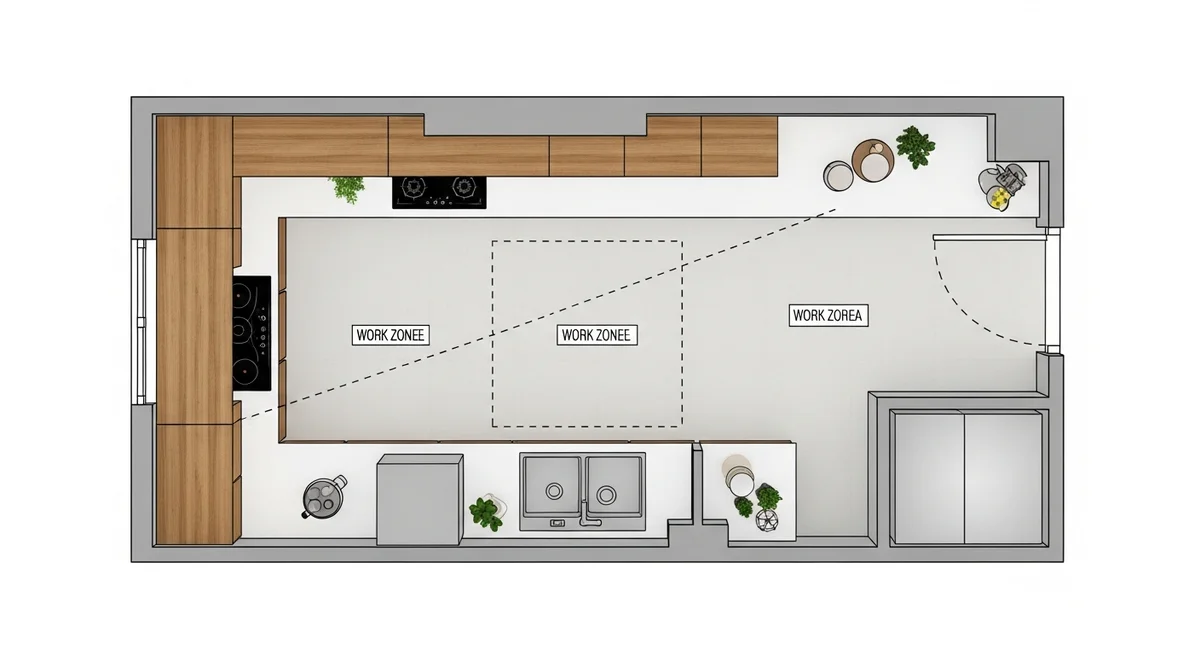
The 3x4 kitchen rule is a design guideline that calls for three separate countertop areas, each about four feet long. These counters serve cooking, cleaning, and food prep. The idea is simple: give each task its own space so you can work without bumping into pans, dirty dishes, or raw ingredients.
This rule helps your kitchen flow better. You move less. You cook faster. And the space just feels right.
In this article, we'll break down what the 3x4 rule really means, how it connects to the classic kitchen work triangle, and whether it works for your home. This is especially helpful if you live in Northern Virginia, where kitchens range from compact townhomes in Arlington to spacious colonial homes in McLean.
What Does the 3x4 Measurement Refer to in Kitchen Design?
The "3" stands for three distinct work zones. The "4" refers to four feet of counter space for each zone.
Here's how those three zones break down:
- Cooking zone: This area holds your stove, oven, and nearby counter space for pots, pans, and hot dishes coming off the burner.
- Cleaning zone: This includes your sink, dishwasher, and counter space for dirty dishes and drying racks.
- Prep and storage zone: This is where your refrigerator and pantry live, along with counter space for chopping, mixing, and meal prep.
When each zone has about four feet of usable counter, you have room to work without things piling up on each other. It also keeps raw meat away from cooked food, which is a smart food safety move.
If you're planning a kitchen renovation, the experts at Mayflower Kitchen and Bath can help you apply this rule to your space.
How Does the 3x4 Rule Improve Kitchen Functionality?
A kitchen without enough counter space can feel like a game of Tetris. You're moving the coffee maker to make room for the cutting board. Then you're shoving dishes aside to drain pasta.
The 3x4 rule fixes this.
By giving each task its own four-foot stretch of counter, you create breathing room. Cooking, cleaning, and prepping happen in their own lanes. No more traffic jams between the sink and stove.
Here's what changes when you follow this rule:
- You walk less between tasks
- Food prep stays separate from cleanup
- Hot pots have a safe landing spot
- Multiple people can work at the same time
According to the National Kitchen and Bath Association (NKBA), an efficient work layout can cut your daily kitchen movement by more than 25%. That's less running around and more actual cooking.
Get a free kitchen design consultation from our Northern Virginia team.
How Does the 3x4 Rule Relate to the Classic Work Triangle?
You may have heard of the "kitchen work triangle." It's a design concept that dates back to the 1940s. The idea places your stove, sink, and refrigerator in a triangle shape so you don't waste steps moving between them.
The 3x4 rule builds on this idea.
Think of it this way: the work triangle tells you where to put your main appliances. The 3x4 rule tells you how much counter space to leave around them.
The NKBA recommends these guidelines for the work triangle:
| Guideline | Measurement |
|---|---|
| Each triangle leg | 4 to 9 feet |
| Total of all three legs | No more than 26 feet |
| Island intersection | No more than 12 inches |
| Work aisle width (one cook) | At least 42 inches |
| Work aisle width (two cooks) | At least 48 inches |
When you combine the triangle placement with the 3x4 counter rule, you get a kitchen that's built for real cooking, not just for looks.
Our kitchen remodeling services help Vienna and Northern Virginia homeowners create layouts that follow these proven design principles.
Should Every Kitchen Follow the 3x4 Rule?
Not every kitchen can follow this rule to the letter. And that's okay.
The 3x4 guideline works best when you have the space for it. U-shaped and L-shaped kitchens handle it well. So do kitchens with islands.
But here's the thing: it's a guideline, not a law.
If your kitchen is smaller, you can still use the thinking behind the rule. Maybe you get two dedicated zones instead of three. Maybe one counter is three feet instead of four. The goal is to create purpose for each area so you're not cramming everything into one spot.
Many Northern Virginia homes have compact kitchens. This is especially true for older townhomes in Fairfax or Vienna. A skilled designer can adapt the 3x4 concept to fit smaller footprints without losing function.
Schedule your free consultation to discuss your kitchen layout options.
Does the 3x4 Rule Apply to Small Kitchens?
Yes, but with adjustments.
Small kitchens may not fit three full four-foot counters. That doesn't mean you throw out the idea. Instead, you scale it down.
Here are some tips for small spaces:
- Prioritize the prep zone. This is where you'll spend the most time. Make sure you have at least 24 to 30 inches of clear counter near the sink.
- Use vertical space. Wall-mounted racks, magnetic knife strips, and overhead shelving free up counter real estate.
- Pick compact appliances. A smaller dishwasher or an over-the-range microwave can give back precious inches.
- Add a rolling cart. A small mobile island adds counter space when you need it and tucks away when you don't.
Even galley kitchens can use a scaled version of the 3x4 rule. Galley layouts have counters on two facing walls. The key is keeping your main work zones within easy reach of each other. Read our guide on kitchen updates for $5,000 for small space ideas.
What Happens If My Kitchen Can't Accommodate the 3x4 Rule?
Life goes on. You adapt.
If your layout just won't fit three four-foot zones, focus on what matters most: separation of tasks. Keep your cooking area away from your cleanup area. Make sure hot pots have a landing spot. Give your prep area enough room to chop and mix safely.
You can also think in terms of "work zones" instead of strict measurements. Many modern designers use this approach. Instead of one triangle, they create mini-zones for each function: storage, prep, cooking, and cleaning.
This zone-based thinking is especially helpful in open-concept homes, where the kitchen blends into living and dining areas.
How Do Kitchen Islands Affect the 3x4 Rule Measurements?
An island can be your best friend or your worst enemy. It all depends on placement.
When done right, an island adds a fourth work zone. It gives you extra prep space, storage below, and maybe even seating for quick meals.
But if the island is too close to your other counters, it can block the work triangle. The NKBA recommends at least 42 inches of clearance around an island. If two people cook together, you need 48 inches.
Here's how to make an island work with the 3x4 rule:
- Use the island as your main prep zone
- Keep the sink and stove on the perimeter
- Add a small secondary sink to the island if space allows
- Leave enough room for cabinet doors and appliance doors to open fully
Islands work especially well in open-concept homes, which are popular in communities like Reston, Ashburn, and other Northern Virginia suburbs.
Use our kitchen visualizer tool to test different island layouts before you commit.
Can Modern Open-Concept Kitchens Still Use the 3x4 Rule?
Absolutely.
Open-concept layouts are everywhere now. This is especially true in new builds and renovated homes across Fairfax County and Loudoun County. The 3x4 rule works great in these spaces because it helps define the kitchen area without walls.
The trick is creating invisible boundaries. Your three zones still exist: cooking, cleaning, and prep. They just flow into a larger room.
An island often serves as the anchor point. It separates the kitchen from the living area and gives you a dedicated prep or eating space.
Pendant lights over the island, a change in flooring, or a waterfall countertop edge can all help define the kitchen zone visually.
Open-concept kitchens also shine for entertaining. You can chat with guests in the living room while stirring a pot on the stove. No more being stuck in a closed-off kitchen.
See real project examples from our Northern Virginia clients.
What Are Alternatives to the 3x4 Rule for Irregular Layouts?
Not every kitchen is a neat rectangle. Some have angles. Some have awkward corners. Some have support columns right where you want to put a cabinet.
When the 3x4 rule doesn't fit, try these alternatives:
- Zone-based design: Instead of fixed measurements, focus on creating distinct areas for each task. Make sure each zone has counter space, storage nearby, and the tools you need.
- Double-triangle layout: For kitchens with multiple cooks, create two overlapping triangles. Each cook gets their own path between key stations.
- Galley efficiency: In narrow kitchens, place the sink and stove on one wall and the fridge on the other. Keep the walkway at least 42 inches wide.
- Peninsula instead of island: If you don't have room for a full island, a peninsula attached to the counter gives you extra prep space and seating without eating up floor space.
The best kitchen layouts meet your life, not some textbook ideal. That's why working with a local expert matters.
Start your kitchen transformation with our Vienna-based design team.
How Do I Measure My Kitchen Triangle Correctly?
Measuring is easier than you think.
Grab a tape measure. Then follow these steps:
- Stand at the center front of your sink.
- Measure from there to the center front of your stove. Write it down.
- Now measure from the stove to the center front of your refrigerator.
- Finally, measure from the fridge back to the sink.
Add up all three numbers. That's your total triangle length.
According to NKBA guidelines:
- Each leg should be between 4 and 9 feet
- The total should be no more than 26 feet
- No leg should cut through an island by more than 12 inches
If your numbers fall outside these ranges, your kitchen may feel cramped or spread out. But don't panic. Most layouts can be improved with smart design changes.
Is the 3x4 Rule More Important Than Other Design Principles?
The 3x4 rule is helpful, but it's not the only thing that matters.
Good kitchen design balances several factors:
- Workflow: Can you move easily between the sink, stove, and fridge?
- Storage: Do you have enough cabinets for your pots, pans, and pantry items?
- Lighting: Is the workspace well lit, especially over the stove and prep area?
- Safety: Are hot surfaces away from high-traffic paths? Do appliance doors have room to open?
- Comfort: Can two people work in the kitchen without bumping elbows?
The 3x4 rule is one piece of the puzzle. It works best when combined with proper aisle width, smart storage, and appliances that fit your space.
View our completed kitchen projects to see how these principles come together.
How Does the 30% Rule Apply to Kitchen Remodeling?
You may have heard of the 30% rule in home remodeling. It suggests that your kitchen renovation budget should be about 5% to 15% of your home's value. It should not exceed 30% of the home's worth.
But there's another way to think about the 30% guideline.
Some designers recommend that about 30% of your kitchen budget go toward cabinetry, 20% toward labor, and the rest toward appliances, countertops, and finishes.
Here's a rough breakdown:
| Category | Budget Share |
|---|---|
| Cabinetry | 25% to 30% |
| Labor and installation | 20% to 25% |
| Appliances | 15% to 20% |
| Countertops | 10% to 15% |
| Flooring and finishes | 10% to 15% |
These numbers flex depending on your priorities. If you love to cook, you might spend more on a high-end range. If storage is your pain point, cabinets might take a bigger slice. Learn more about where your kitchen budget goes.
Final Thoughts
The 3x4 kitchen rule is a smart, simple guideline. It tells you to create three work zones for cooking, cleaning, and prep. Each zone should have about four feet of counter space.
When you follow this rule, your kitchen flows better. You walk less. You cook more. And meal prep stops feeling like a chore.
But rules are made to be bent. If your kitchen is small, oddly shaped, or open to the living room, you can still use the thinking behind the 3x4 rule. The goal is giving each task its own space so nothing piles up where it shouldn't.
The team at Mayflower Kitchen and Bath has designed kitchens for all kinds of Northern Virginia homes. We serve homeowners in Vienna, McLean, Great Falls, Fairfax, Reston, Arlington, and throughout the region.
Book your free consultation today and let's design a kitchen that works for your life.