July 8, 2026
Best Wood for a Sauna: Cedar vs. Other Species (and the Regulations to Know)
DESIGN


Key Takeaways
For many Northern Virginia homeowners, the sauna decision starts with one practical question: do you want the classic heat of a traditional sauna, or the lower-temperature comfort of infrared? Both can be excellent choices when they are planned correctly. The better option depends on how you want to use the space, how much room you have, what heat level your family can tolerate, and whether the sauna is meant to be a permanent luxury feature or a compact wellness upgrade.
A traditional Finnish sauna runs hotter, typically 150 to 195°F, and usually takes 30 to 45 minutes to heat. An infrared sauna operates at a lower 100 to 140°F and heats up faster, usually in 10 to 15 minutes. That one difference affects almost everything: comfort, energy use, installation planning, and daily use.
The right answer is not the same for every home. If you want a true spa-style experience with stone heat, wood benches, and a permanent built-in feel, traditional may be the stronger choice. If you want faster heat-up, lower operating temperature, and a smaller footprint, infrared may make more sense.
Factor | Traditional Sauna | Infrared Sauna |
|---|---|---|
Temperature | 150 to 195°F | 100 to 140°F |
Heat-up time | 30 to 45 minutes | 10 to 15 minutes |
Energy use | 3 to 6 kWh per session | 1.5 to 3 kWh per session |
Typical cost | Pre-built barrel sauna: $3,000 to $8,000. Custom room: $15,000 to $35,000+ installed | Pre-built cabin: $3,000 to $10,000. Custom room: $10,000 to $25,000 installed |
Space needed | Minimum 4x4 ft interior | Can fit in about 2.5x3 ft |
Health and comfort | Classic high-heat sauna experience | Lower heat can be easier for heat-sensitive users |
Installation complexity | Often more construction planning, ventilation, electrical, and material coordination | Usually simpler, especially for smaller cabins, but custom rooms still require careful planning |
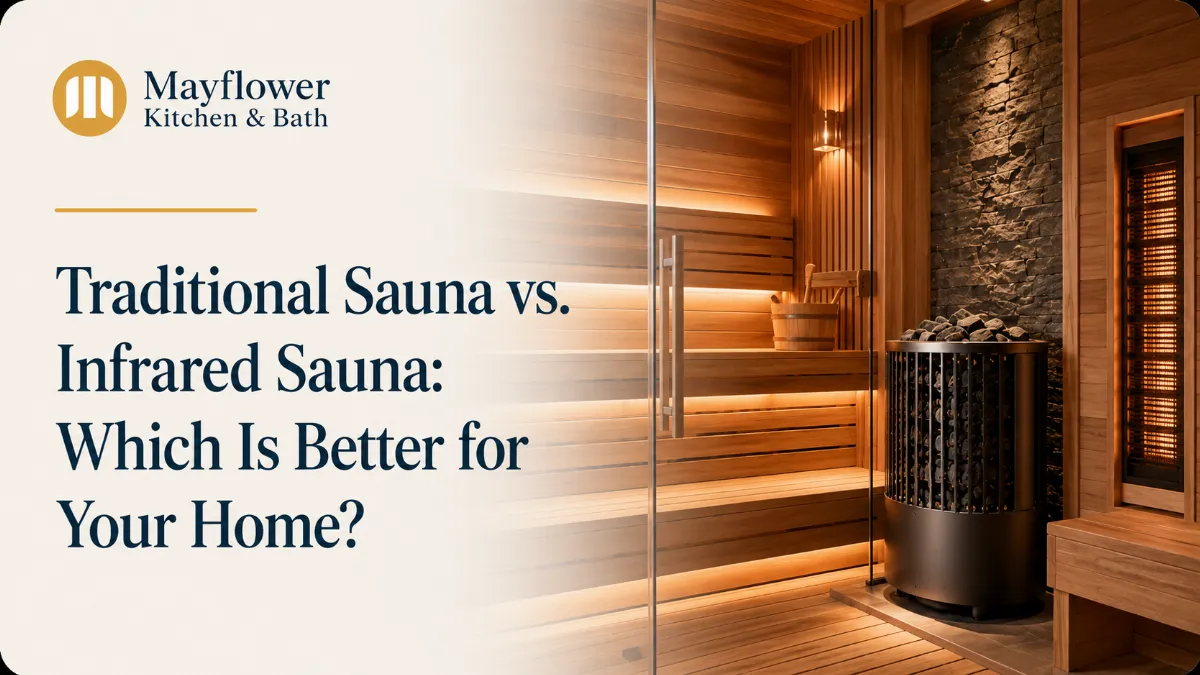
A traditional sauna heats the room itself. The heat source warms the air, the walls, the benches, and often sauna stones. That creates the intense dry heat many people associate with Finnish sauna bathing.
This is the option most homeowners picture when they think of a custom home sauna: wood-lined walls, tiered benches, a heater with stones, warm lighting, and a dedicated room that feels built into the house. Traditional saunas also remain the largest global category, with 42.79% market share in 2025.
The tradeoff is patience and planning. A traditional sauna typically takes 30 to 45 minutes to heat, and it uses about 3 to 6 kWh per session. It also needs enough room to feel comfortable. A 4x4 ft interior is usually the minimum, but many homeowners prefer more space once they imagine two people, bench depth, door swing, and safe heater clearance.
Infrared saunas use infrared panels to heat the body more directly instead of heating the room to the same high temperature. The room still gets warm, but the experience is milder. Infrared saunas typically operate at 100 to 140°F and heat up in about 10 to 15 minutes.
That lower temperature is the main advantage. Infrared can be more accessible for users who cannot tolerate the intense heat of a traditional sauna. It is also more energy-efficient per session, typically using 1.5 to 3 kWh.
Infrared is also gaining demand. It is the fastest-growing sauna segment, with a 7.5% CAGR projected through 2033. The US infrared sauna market is listed at $290.85M in 2025 and projected to reach $378.70M by 2030. For homeowners who want a wellness feature that is quick to use during the week, that growth makes sense.
The most budget-friendly options are usually pre-built units. A pre-built traditional barrel sauna typically costs $3,000 to $8,000. A pre-built infrared cabin usually costs $3,000 to $10,000.
Custom rooms are a different category. A custom-built traditional sauna typically costs $15,000 to $35,000+ installed. A custom infrared room typically costs $10,000 to $25,000 installed. These numbers depend on size, location, electrical needs, wood selection, glass, bench design, lighting, controls, and how integrated the sauna is with the bathroom, basement, gym, or wellness area.
Built-in custom saunas held 68.2% market share in 2025, which says a lot about homeowner preference. Pre-built units can work, but built-in saunas usually feel more permanent, more intentional, and more aligned with luxury home value.
Smart features are also becoming more common. App control, chromotherapy, and audio appeared in 34% of new sauna installations in 2025. These upgrades can make daily use easier, but they should be planned carefully so the sauna remains clean, durable, and safe.
Both traditional and infrared saunas can support a wellness routine, but homeowners should avoid treating either one as a medical device. The strongest health-related statistic in the brief comes from the 20-year Finnish Kuopio study, which found that sauna use 4 or more times per week reduced cardiovascular disease risk by up to 66%.
That study is often discussed in relation to traditional Finnish sauna use, so it should not be used to claim that every sauna type produces the same result for every person. For most homeowners, the practical decision is comfort and consistency. A sauna only helps your routine if you actually use it.
Traditional saunas suit people who enjoy intense heat and a classic ritual. Infrared saunas suit people who prefer lower temperatures, faster sessions, and easier weekday use.
Choose a traditional sauna if you want the most authentic sauna experience, a high-end built-in room, and a feature that feels like a luxury spa addition. It is often the better fit for homeowners planning a full bathroom remodel, basement wellness area, home gym, or custom lower-level retreat.
Choose an infrared sauna if you want quicker heat-up, lower operating temperature, lower session energy use, and a smaller footprint. It can be a smart option for homeowners with limited space or family members who may not tolerate 150 to 195°F heat well.
Choose a custom built-in sauna if this is part of a serious long-term renovation. A permanent sauna can be designed around the room, not forced into it. That means better bench layout, cleaner electrical planning, better material coordination, and a finished look that matches the rest of the home.
Planning a custom sauna for your Northern Virginia home? Mayflower can help you compare sauna types, plan the right layout, and build a finished space that fits your home properly. Learn more on our Custom Sauna Construction Service Page